Part 2 of 8: A Dark Bedroom May Be One of the Kindest Gifts We Give Our Bodies
From "When Counsel Meets Evidence", an eight-part series exploring Ellen White’s health counsel in conversation with modern science.
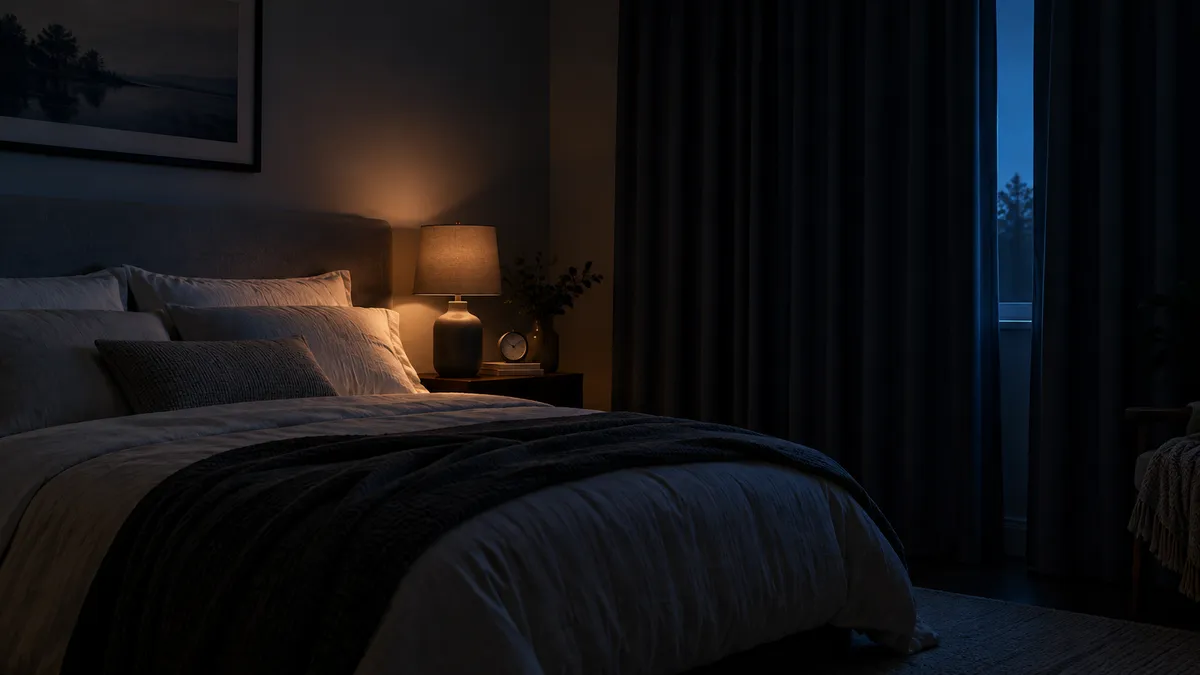
My bedroom can look dark and still be full of tiny lights.
The alarm clock glows. A charger blinks. Light slips around the curtain. A phone wakes on the nightstand when a notification arrives. None of it feels dramatic, which is probably why it is so easy to ignore.
Then I read Ellen White’s counsel to her secretaries from 1888: “Make it a habit not to sit up after nine o’clock. Every light should be extinguished.” She called turning night into day a health-destroying habit.
The wording is strong. But the principle behind it has become increasingly familiar: our bodies need a real contrast between day and night.
Darkness is biological information
Light does more than help us see. It tells the brain what time it is.
Specialized cells in the retina send light information to the body’s central circadian clock. In the evening, darkness helps the body begin its biological night. Melatonin rises as part of that process. Morning light sends the opposite message, helping set the timing of wakefulness and the next night’s sleep.
In a controlled study of 116 healthy adults, ordinary room light before bedtime—less than 200 lux—delayed melatonin onset in nearly every participant and shortened the duration of melatonin production by about 90 minutes compared with very dim light. That does not mean a single stray photon turns off melatonin throughout the body. It does mean that evening light exposure can matter more than it appears.
A 2024 study added a much larger, longer view. Nearly 89,000 UK Biobank participants wore light sensors for a week and were then followed for about eight years. Brighter nights were associated with higher mortality risk, while brighter days were associated with lower risk. Because this was observational research, it cannot prove that light exposure itself caused those outcomes. Yet the pattern is consistent with what circadian biology has been showing for years: bright days and dark nights support a stronger biological rhythm.
This is bigger than sleepiness
When my nights are bright and my days are dim, the issue is not simply whether I feel tired the next morning. Circadian timing helps coordinate metabolism, cardiovascular function, hormone release, alertness, and sleep.
Persistent night-shift work is an especially important case. The U.S. National Institute for Occupational Safety and Health notes that major reviews have classified night-shift work involving circadian disruption as probably carcinogenic to humans. That finding is about long-term occupational exposure, not an occasional late evening. It should lead to better workplace protection and medical guidance, not guilt for people whose jobs require nights.
It also reminds me that darkness is not empty. Rest is not wasted time. Night has a God-given purpose.
A kinder evening
I do not read Ellen White’s “after nine o’clock” as a universal command that ignores season, age, work, caregiving, or individual sleep needs. I read it as an unmistakable direction: stop treating night like an extension of the workday.
For me, that can look simple:
- dim unnecessary lights during the last hour or two before bed;
- use warmer, lower lighting instead of bright overhead fixtures;
- keep the phone out of reach—or out of the room;
- cover or remove small LEDs that brighten the bedroom;
- use curtains, shades, or a comfortable eye mask when outside light intrudes;
- get meaningful outdoor light during the day, especially after waking.
Darkness should never come at the expense of safety. Hallway lighting, fall prevention, children’s needs, and medical equipment matter. The goal is not an absolute rule. It is a healthy pattern.
If insomnia is persistent, loud snoring is present, breathing pauses are suspected, or daytime sleepiness is interfering with life, a darker room is not a substitute for medical care. Sleep disorders deserve proper evaluation.
A small act of stewardship
Sometimes health advice sounds expensive and complicated. This one is almost embarrassingly ordinary: let night be night.
Turn off what does not need to be on. Let the room grow quiet. Let the darkness tell the truth about the hour.
My body was not designed to perform without interruption. It was designed to move through light and darkness, labor and rest. Protecting that rhythm may be one of the simplest ways I can practice gratitude for the body God has given me.
Here's to a good nights sleep,
Victoria
Credits and further reading
- Primary conversation: Dr. David Shin and Dr. Roger Seheult, [*Here We Stand* episode](https://podcasts.apple.com/us/podcast/ellen-white-made-some-remarkable-health-claims-were/id1874466573?i=1000790572112)
- Ellen G. White, [*Manuscript Releases*, vol. 9, p. 46](https://m.egwwritings.org/en/book/59.240)
- Gooley and colleagues, [room light before bedtime and melatonin](https://pubmed.ncbi.nlm.nih.gov/21193540/), Journal of Clinical Endocrinology & Metabolism (2011)
- Windred and colleagues, [personal light exposure and mortality in more than 88,000 people](https://pubmed.ncbi.nlm.nih.gov/39405349/), PNAS (2024)
- CDC/NIOSH, [night-shift work, circadian disruption, and cancer](https://www.cdc.gov/niosh/bulletin/2021/nightshift-cancer.html)
Health note: This article is educational and is not individualized medical advice.


