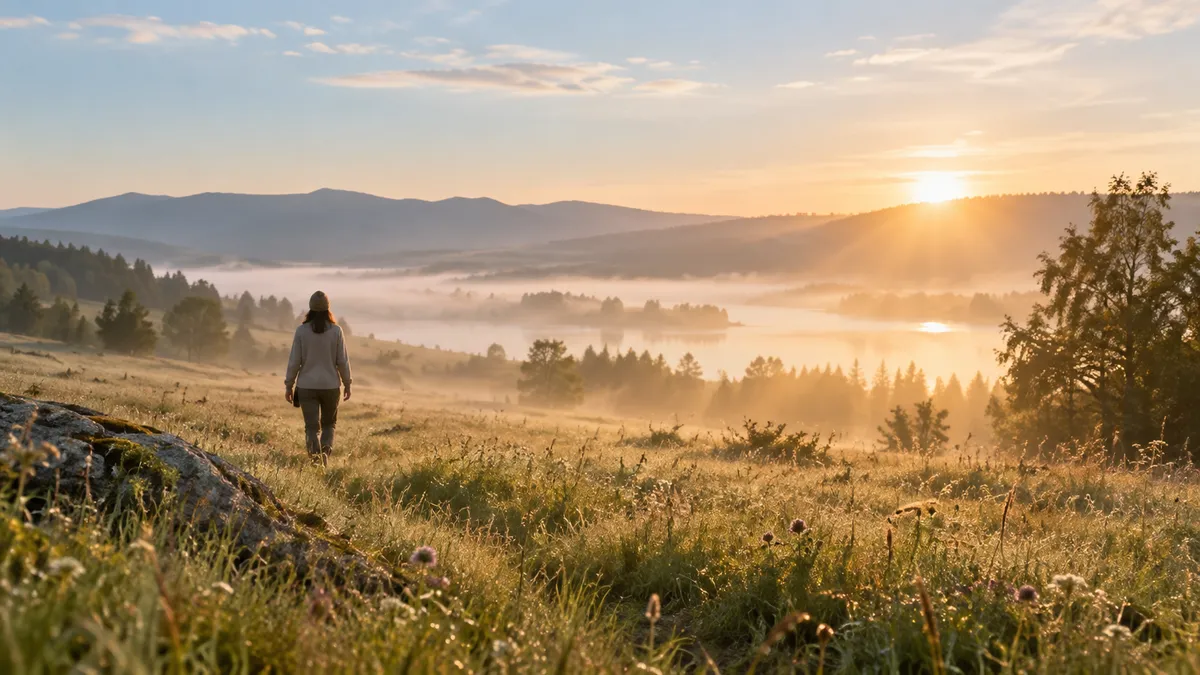
Part 5 of 8: The Forgotten Medicine of Sunlight
From *When Counsel Meets Evidence**, an eight-part series exploring Ellen White’s health counsel in conversation with modern science.*
We have made health feel very complicated.
We track, optimize, supplement, subscribe, and compare. Some of that can be useful. But in the middle of all our technology, I wonder whether I have overlooked one of the most available gifts in the world: stepping outside into the light.
In an 1871 Health Reformer article, Ellen White urged the “pale and sickly” to go out into the light and warmth of the sun. Elsewhere she connected abundant sunlight, pure air, and physical exercise with health and cheerfulness.
Her language is vivid. The best modern evidence invites me to take the principle seriously without turning sunlight into a cure-all.
Light sets the clock
The strongest case for daylight begins with circadian biology.
Light reaching the eyes helps synchronize the body’s daily timing system. Morning and daytime light support alertness and help establish when biological night will begin. At night, a darker environment reinforces the contrast. The body does not thrive on brightness alone; it thrives on light at the right time and darkness at the right time.
A 2024 study of nearly 89,000 people found that brighter daytime light was associated with lower mortality risk, while brighter nighttime light was associated with higher risk. This does not prove that simply standing in the sun will lengthen life. People who receive more daylight may differ in activity, health, occupation, and many other ways. Yet the study adjusted for several major factors, and its overall pattern fits established circadian science.
Light and mood
The connection between light and mood is also more than a metaphor.
Seasonal affective disorder is a recurring form of depression often associated with the darker months of the year. The National Institute of Mental Health lists bright-light therapy among established treatments for winter-pattern SAD. That therapy is controlled, timed, and typically delivered with a UV-filtered light box; it is not the same as simply “getting more sun.” Still, its effectiveness reminds us that light is a real biological signal with effects on mood and sleep timing.
For ordinary low mood, going outside may also help because several good things arrive together: light, movement, a change of setting, contact with nature, and often human connection. It is difficult to separate them—and perhaps I do not always need to.
Depression is not a character flaw, and a walk outdoors is not a replacement for appropriate mental-health care. If symptoms are persistent, severe, or include thoughts of self-harm, professional help is essential.
What about infrared light?
In the interview, Dr. Roger Seheult discussed infrared and near-infrared wavelengths, mitochondrial function, and possible effects on cellular energy production. This is a lively area of research, but some proposed mechanisms remain under investigation. I would rather say “promising” than “proven” where the evidence is still developing.
Sunlight is a broad spectrum. Its effects cannot be reduced to vitamin D alone, and researchers are studying pathways involving circadian timing, nitric oxide, immune function, and photobiomodulation. That is fascinating. It is also a reason to resist oversimplified claims that one wavelength explains everything.
Ellen White gave a practical direction—go outdoors—without pretending to provide a modern physiology textbook. The wisdom may lie partly in the wholeness of the act.
The doorway is closer than the supplement shelf
My response does not need to be dramatic.
- I can take my first cup of water or morning prayer outside.
- I can move a phone call to a walking path.
- I can sit near daylight during the day and dim my environment in the evening.
- I can give children regular outdoor time without making it a special event.
- I can notice how many daylight hours I spend behind glass.
Sunlight is not safe in unlimited doses, and the next post in this series will deal directly with UV risk and protection. The goal is neither fear nor worship of the sun. It is to receive daylight as part of the created order—with gratitude, good judgment, and respect for the body.
Sometimes the first step toward feeling more alive is not another purchase. It is opening the door.
Love & light,
Victoria
Credits and further reading
- Primary conversation: Dr. David Shin and Dr. Roger Seheult, [*Here We Stand* episode](https://podcasts.apple.com/us/podcast/ellen-white-made-some-remarkable-health-claims-were/id1874466573?i=1000790572112)
- Ellen G. White, [“Sunlight,” including the May 1, 1871 Health Reformer passage](https://text.egwwritings.org/read/388.1702) and [the April 1, 1871 Health Reformer article](https://text.egwwritings.org/read/504.181)
- National Institute of Mental Health, [Seasonal Affective Disorder](https://www.nimh.nih.gov/health/publications/seasonal-affective-disorder)
- Windred and colleagues, [day/night light exposure and mortality](https://pubmed.ncbi.nlm.nih.gov/39405349/), PNAS (2024)
Health note: Light therapy can interact with certain eye conditions, medications, and bipolar disorder. Use clinical guidance when treating a health condition.


