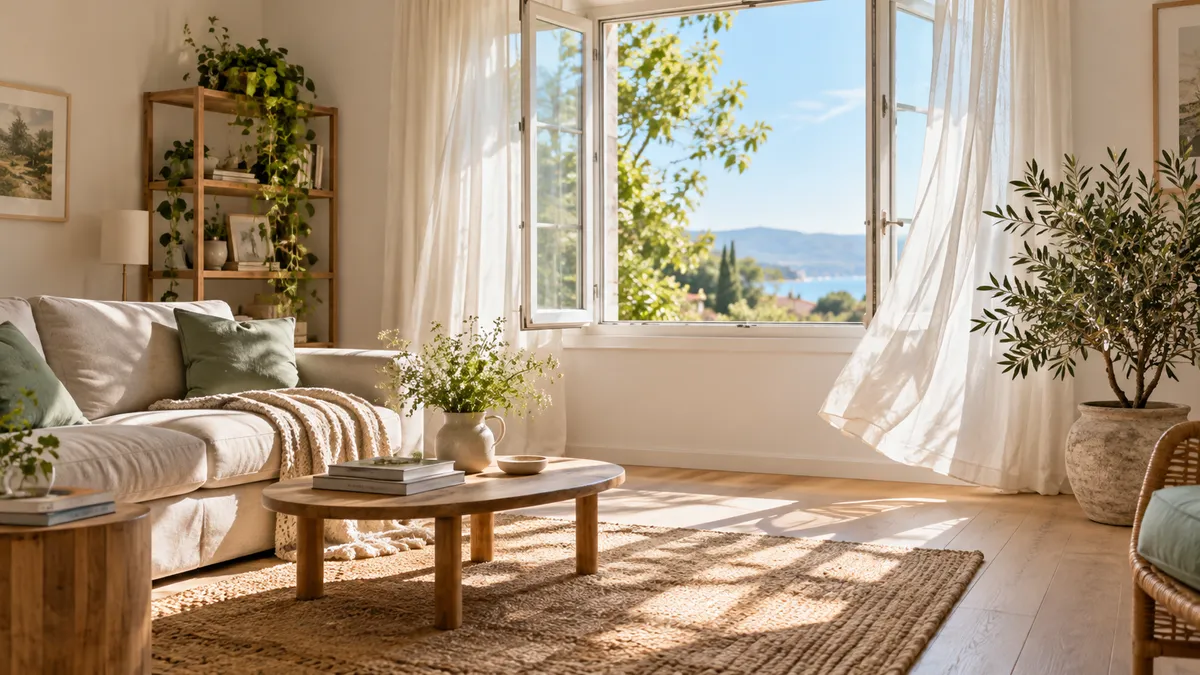
Part 6 of 8: Open the Blinds. Open the Windows.
From *When Counsel Meets Evidence**, an eight-part series exploring Ellen White’s health counsel in conversation with modern science.*
I can keep a room so carefully that I make it unlivable.
Curtains remain closed so fabric will not fade. Windows stay shut because the weather is inconvenient. The “good room” is protected for company while the people who actually live in the house gather somewhere dimmer.
Ellen White had little patience for that kind of housekeeping.
In an April 1, 1871 Health Reformer article, she told parents not to close their blinds against the sun or reserve the pleasant rooms only for visitors. She described sunlight and fresh air as gifts meant to be welcomed into the home.
The house, in her telling, was not a museum. It was a place for life.
Light changes a room
Daylight does not sterilize an entire house, and it should not be marketed as a substitute for cleaning, moisture control, or infection prevention. Yet sunlight can help dry materials, discourage some damp-loving organisms, and—just as importantly—change how a room feels and how we use it.
A bright room invites wakefulness during the day. It reinforces the difference between day and night. It may encourage us to move, work, read, or gather rather than retreat into a cave of artificial light.
That psychological effect matters. A home should protect us, but it should not cut us off from the created world outside it.
Fresh air is not a decorative idea
Modern indoor-air research supports the basic importance of ventilation. The U.S. Environmental Protection Agency explains that inadequate ventilation can allow pollutants from indoor sources to accumulate. Humidity can increase some problems, including mold growth.
The answer depends on the building, climate, air quality, and occupants. Opening windows can be helpful when outdoor air is clean and conditions are safe. At other times—during wildfire smoke, extreme heat, severe cold, or high outdoor pollution—mechanical ventilation and filtration may be the wiser choice.
The principle is not “windows must always be open.” The principle is that indoor air needs intentional care.
Carbon dioxide monitors are sometimes used as rough indicators of how well occupied spaces are ventilated. They do not measure every pollutant and are not complete indoor-air-quality devices. Still, a sharply rising reading in a crowded, closed room can reveal what our noses have learned to ignore: the room needs better air exchange.
A necessary word about radon
The interview connected ventilation with radon, a radioactive gas that can enter homes from the soil and increase lung-cancer risk. Opening windows may temporarily lower a radon reading, but it is not a dependable long-term solution.
The EPA’s advice is clear: test the home. If radon is elevated, use a proper mitigation system installed by a qualified professional. This is one place where a simple slogan—“just open the windows”—would be unsafe.
Good stewardship means using the right tool for the problem.
Credit where credit is due
The same 1871 article contains a memorable passage about women protecting their “lily-white” cheeks from the sun while they themselves become pale and weak. The article explicitly introduces those words as a quotation from The Herald of Health.
That detail matters. Ellen White selected and republished the passage, but responsible writing should not present every line as though she originated it. Giving credit does not weaken the point. It tells the truth about how the text reached us.
A simple healthy-home reset
I can begin without renovating the house:
- open curtains and blinds during the day;
- air out rooms when outdoor conditions are healthy and safe;
- use exhaust fans when cooking or bathing;
- repair leaks and control persistent moisture;
- maintain heating, cooling, filtration, and ventilation systems;
- test for radon instead of guessing;
- avoid smoking and unnecessary combustion indoors;
- let the best room serve the people who live there.
I love that last one.
Health is not only about removing hazards. It is also about welcoming what gives life: light, air, movement, relationship, and use. The room does not need to be preserved from living. It needs to support it.
So I will open the blinds. When conditions allow, I will open the windows. And I will remember that a home is most beautiful when it helps its people breathe.
Be well,
Victoria
Credits and further reading
- Primary conversation: Dr. David Shin and Dr. Roger Seheult, [*Here We Stand* episode](https://podcasts.apple.com/us/podcast/ellen-white-made-some-remarkable-health-claims-were/id1874466573?i=1000790572112)
- Ellen G. White, [April 1, 1871 Health Reformer article](https://text.egwwritings.org/read/504.181). The “lily-white” passage is credited within the article to The Herald of Health.
- U.S. EPA, [Protect Indoor Air Quality in Your Home](https://www.epa.gov/indoor-air-quality-iaq/protect-indoor-air-quality-your-home)
- U.S. EPA, [Radon risks and solutions](https://www.epa.gov/radon/radon-risks-and-solutions) and [guidance noting that natural ventilation is only temporary mitigation](https://www.epa.gov/sites/default/files/2016-12/documents/2016_consumers_guide_to_radon_reduction.pdf)
Health note: Follow local air-quality alerts, building guidance, and professional advice for mold, combustion hazards, or elevated radon.


