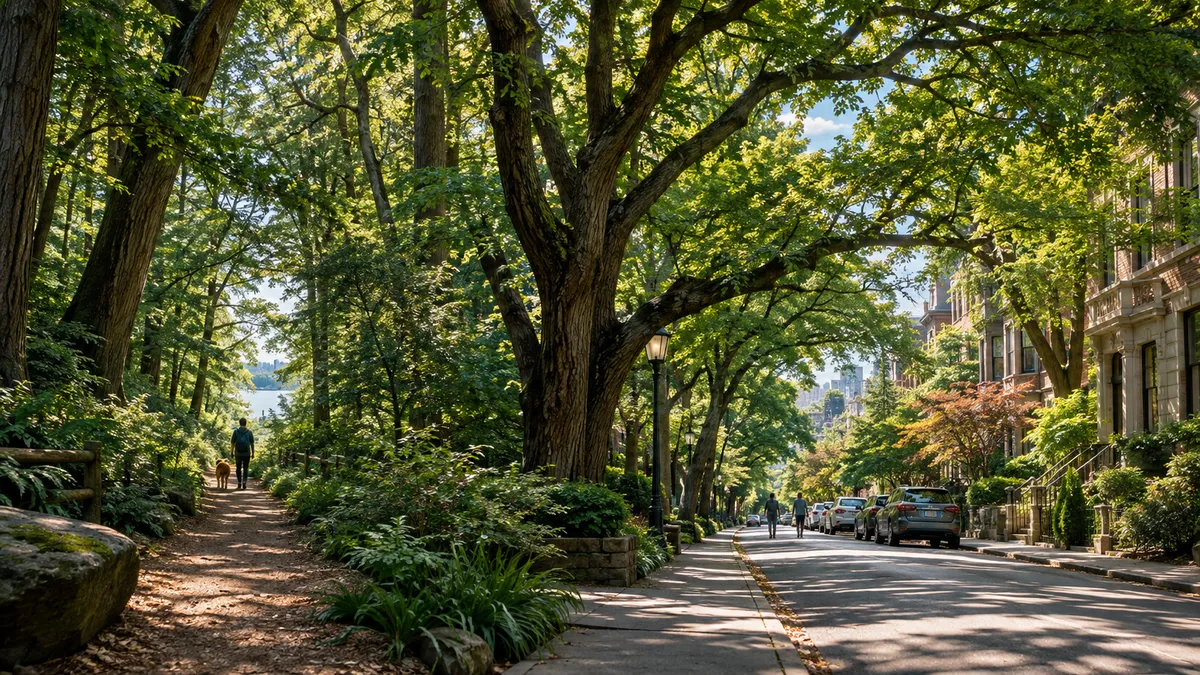
Part 4 of 8: Trees Are More Than Scenery
From *When Counsel Meets Evidence**, an eight-part series exploring Ellen White’s health counsel in conversation with modern science.*
I have walked into the woods carrying a mind full of noise and come out quieter.
Nothing spectacular happened. No prescription changed. No problem disappeared. I simply spent time under trees, breathed differently, walked at a human pace, and returned with more room inside me.
Ellen White wrote that “the pure air, the glad sunshine, the beautiful flowers and trees” and outdoor exercise were health-giving. She spoke of restorative properties in pine, cedar, fir, and other trees, and urged people to cherish and plant them.
For years, language like that could be heard as poetic encouragement. Today, researchers are trying to measure what green space may actually do.
What the forest studies found
Dr. Roger Seheult referenced Japanese research on “forest bathing”—unhurried time spent walking and resting in a forest atmosphere. Remember, I have an oil called Shinrin Yoku that can help you bring this practice inside your home!
In one small study led by Qing Li, twelve healthy men took a day trip to a forest park and walked for several hours. Researchers measured natural killer cell activity, immune-cell counts, stress hormones, and proteins involved in immune defense. Several measures improved after the trip, and increased natural killer cell activity was still present seven days later. The researchers detected airborne plant compounds called phytoncides and proposed that these compounds, along with reduced stress, might contribute.
That is intriguing, but it is not proof that a weekly forest walk prevents cancer. The study was small, involved a narrow group of participants, and measured biomarkers—not long-term disease outcomes. I can appreciate the finding without asking it to say more than it does.
The larger lesson is still valuable: a forest is not merely a backdrop for exercise. It is a sensory and biological environment.
What happened when a city planted trees
The Green Heart Louisville Project approached the question at neighborhood scale.
Researchers studied a four-square-mile area, collected baseline health and environmental data, then worked with community partners to add more than 8,000 mature trees and shrubs in selected clusters. After planting, residents in the greened areas had high-sensitivity C-reactive protein levels about 13 to 20 percent lower than residents in comparison areas without the added greenery. This blood marker is associated with inflammation and cardiovascular risk.
Again, a biomarker is not the same as a prevented heart attack or stroke. The project does not mean every tree produces a predictable percentage reduction in disease. But it is an unusually ambitious attempt to move beyond the familiar observation that healthier people often live in greener places.
Trees can cool streets, filter some air pollution, reduce noise, invite walking, create beauty, and change how a neighborhood feels. Health may come through several pathways at once. That complexity is not a weakness. It is part of what makes creation so difficult to reduce to a pill.
Nature is not a replacement for care
When Ellen White said outdoor life was the only remedy some people needed, I hear a challenge to our neglect of ordinary necessities—not a command to refuse appropriate treatment.
A walk in the woods does not replace insulin, surgery, trauma care, antibiotics, psychotherapy, or a careful diagnosis. It is also true that medicine can become so focused on interventions that we forget the conditions in which human beings were made to live.
We need both humility and proportion.
My practical response
We may not live beside a forest, but we can stop treating green space as decoration.
- We can choose a tree-lined route when I walk.
- We can sit under a tree without filling the silence with my phone.
- We can support shade trees around schools, churches, sidewalks, and homes.
- We can plant for the people who will live here after me.
- We can let one outdoor hour become a regular appointment rather than an occasional reward.
There is something deeply Christian about planting a tree whose full shade I may never enjoy. It is hope made visible. It is care for a neighbor I may never meet.
Trees are not magic. They are not medicine in a bottle. They are living members of the environments that shape our bodies, our communities, and our attention.
Perhaps the surprising thing is not that trees can support health. Perhaps it is how thoroughly we built a modern life that forgets them.
Here's to enjoying the trees around us,
Victoria
Credits and further reading
- Primary conversation: Dr. David Shin and Dr. Roger Seheult, [*Here We Stand* episode](https://podcasts.apple.com/us/podcast/ellen-white-made-some-remarkable-health-claims-were/id1874466573?i=1000790572112)
- Ellen G. White, [*The Ministry of Healing*, pp. 263–264](https://text.egwwritings.org/read/135.1309) and [*Testimonies for the Church*, vol. 7, pp. 76–79](https://m.egwwritings.org/fr/book/117.403)
- Qing Li and colleagues, [a day trip to a forest park and immune markers](https://pubmed.ncbi.nlm.nih.gov/20487629/), Journal of Biological Regulators and Homeostatic Agents (2010)
- Green Heart Project, [design and methods](https://pmc.ncbi.nlm.nih.gov/articles/PMC13148999/) and [University of Louisville summary of the first inflammation findings](https://news.louisville.edu/news/uofl-green-heart-project-residents-inflammation-lower-after-trees-added-neighborhoods)
---
Previous: [Part 3 — The Holy Rhythm of Regular Sleep](03-holy-rhythm-regular-sleep.md)
Next: [Part 5 — The Forgotten Medicine of Sunlight](05-forgotten-medicine-sunlight.md)
[View the complete series](README.md)


